
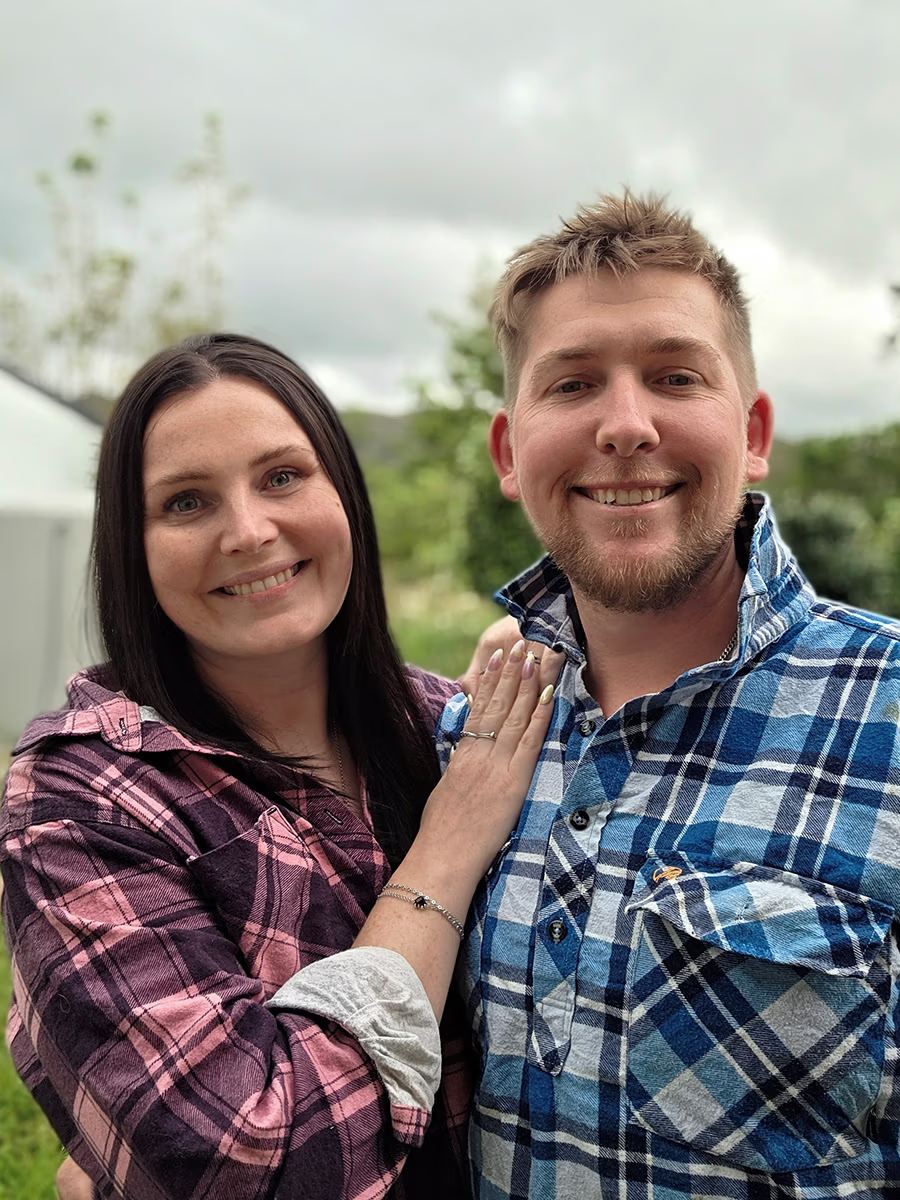
From trainees to sharemilkers, Karl and Jess Wood credit the NZ Dairy Industry Awards with shaping their careers, driving progress and reflection on farm today.
For 2026 Manawatu Sharefarmers of the Year Karl and Jess Wood, the NZ Dairy Industry Awards isn’t just a line on their CV: it’s been an experience on which their career has hinged.
From dairy trainees to managers and now sharemilkers, each stage of their progression through the dairy industry has been shaped by the skills, opportunities and connections they have been afforded by the awards experience.
“Our whole career has been a product of these awards,” Karl says.
As first-time entrants to Sharefarmer of the Year, Karl and Jess once again stepped outside their comfort zone – not necessarily for the silverware, but for the chance to benchmark their business, reflect on what they do well and identify where they can improve.
“Sharefarmer of the Year is a different kettle of fish,” Karl says. “It’s harder to collate all the information into a two-hour presentation and present it well, but we thought judging went quite well.”
The willingness to put themselves up for scrutiny is nothing new, for Karl at least: long before Sharefarmer of the Year, the foundations were laid at his home – Milking Shorthorn stud Northbrook, where his parents David and Johanna showed cattle extensively.
After high school, Karl headed to university, spending a year and a half studying before realising his passion was in the paddock, rather than the classroom.
“I’d really just gone to university because my friends had,” he admits. “I came back to the home farm to work, and I later worked at farms in Manawatu and Canterbury before landing at our current position.”
Karl and Jess are now in their fifth year as herd owners, 50/50 sharemilking for John Gardner (Wyke Partnership) at Shannon. They milk 230 cows across 85ha effective, plus an adjoining 19ha lease block. Aside from grazing heifers off farm, all stock is wintered on the property.
The Woods milk through a 24-a-side herringbone shed, which Karl describes as “a really good fit for our herd size”, and run a System 3, pasture-based system with a few palm kernel trailers.
Production is climbing steadily: over their first three seasons, the herd averaged 440kgMS/cow, while last season they were tracking closer to 480kgMS/cow.
“Next season I’d love to push that to 500kgMS/cow,” Karl says.
Last season also saw the introduction of chicory and fodder beet into the system, providing extra flexibility and a ‘safety net’ during lactation.
The farm’s geography works in their favour, the surrounding hills offering some protection during summer. Traditionally, they’ve moved to once-a-day milking by late January, but last season the cows held their condition well enough to remain on twice-a-day milking well into February.
“But it is a condition-based decision,” Karl says. “Because we don’t feed maize, they need to have good condition on them and get to their pre-calving weight before we dry them off.”
At the heart of Karl and Jess’ operation is a strong breeding focus for their ‘licorice allsort’ herd: Holstein Friesians, Milking Shorthorns, Jerseys, Guernseys, Brown Swiss and Crossbred, with the latter making up around half.
“Regardless of the breed, the goal is to breed them all up to a cow that produces 100 percent of her liveweight,” Karl says. “I want a good, robust, open cow; a 500kg cow doing 500kgMS.”
In that ilk, Karl is actively breeding Jerseys bigger and Holstein Friesians slightly smaller, targeting a medium-stature cow with strong capacity and feed efficiency.
“I really like Holstein Friesians for their feed efficiency,” he says. “They’re the cows I can get to do their liveweight, if not more. I want to breed a medium-stature Holstein Friesian; a powerhouse cow that has great capacity and efficiency. They are good at turning quality pasture into milk.”
Last season, Karl used 36 different bulls across the herd.
“It’s all planned out and laminated: what, who, why,” he says. “When you start seeing the wins from that work, which we’re seeing now in our fourth season, that’s the fun part.”
Among the Holstein Friesian genetics he’s watching closely are daughters of Delta Lucardi, who has “shot up” the RAS list; three of his daughters are having DNA work done for potential contracts, and more are due to calve next season.
Karl is also milking a few Westcoast Almamater daughters and has some “beautiful” Westcoast Midmarch daughters yet to come into milk.
The herd is 100 percent AI mated, supported by SmaXtec boluses which monitor herd health, reproduction and feeding behaviour.
“We’ve utilised the most cost-effective technology for us, which provides us with good data,” Karl says.
They mate the top 40% of cows to dairy, and the rest to beef. Last season they also increased their use of sexed semen, aiming to lift the quality of replacements coming through.
“Hopefully we’ll get a better group of heifers from our best cows,” Karl says. “We are also breeding the crossbred portion of the herd more to black and white now, trying to increase their total yield while keeping their components.”
Calving starts on July 16, with replacement numbers depending on what comes through, though they typically retain around 45 heifers.
Beyond the day-to-day rhythms of the farm, Karl is no stranger to stepping back and measuring progress against the wider industry.
His history with the NZ Dairy Industry Awards is solid: in addition to the couple winning Manawatu Sharefarmer of the Year in 2026 – and placing third in the national Sharefarmer of the Year competition – Karl entered and won the Manawatu Regional Dairy Manager of the Year in 2016, placing runner-up nationally, and won Manawatu Dairy Manager of the Year in 2021.
“I always get a lot out of doing it,” he says. “My whole career has been a product of these awards. After I won Manawatu Dairy Trainee of the Year, I worked for that year’s winning Sharefarmer of the Year, and when I won Manawatu Dairy Manager of the Year, I took on that year’s winning Sharefarmer of the Year’s job another season later. If I hadn’t been involved, I wouldn’t have got that initial introduction.”
Beyond the NZ Dairy Industry Awards, Karl also participated in the 2025 Holstein Friesian NZ Young Breeders Development Programme, which he credits with broadening his thinking beyond the farm gate.
“I don’t think you realise just how much you’ve learnt until afterwards, when you start to see it show up in your work and everyday life,” he says. “A big takeaway was understanding what effective governance actually looks like, and, if you’ve got a great idea, you need a great strategy – otherwise it just won’t work. The programme was good for personal and professional development for me.”
Alongside building their business, Karl and Jess are raising their young daughter, Daisy, adding another layer to decision-making and future planning.
“Our little one’s still young, so we’re starting to think more about long-term stability,” Karl says. “We’d like something that feels more permanent, and where we can spread our wings and increase our herd size to 450-500 cows.
“In saying that, we absolutely love our job. We’ve got a great set-up here and we are on our way to building a herd.”
Karl’s respect for the people who have helped him along the way is clear, particularly for John Gardner.
“John’s always had first-time sharemilkers on his farm,” Karl says. “A lot of careers have started here, and we’re privileged to be part of that.”
He says it has been plain to see that success breeds success.
“When you come onto a farm that’s been operated well, initially it’s about maintaining that standard, and after a couple of seasons you see what you can improve,” he says. “The end result is a product of everyone’s work, making sure the soils, pasture and infrastructure are well cared for.”
While time has been limited with a young family, Karl hopes to return to showing cattle in the coming years.
“The passion’s still there,” he says.
| Owner | Wyke Partnership (John Gardner) |
| 50/50 Sharemilkers | Karl & Jess Wood trading as Kowhai Acres Limited |
| Location | Shannon, Manawatu |
| Farm size | 85ha effective |
| Cows | 230 (10% registered Holstein Friesian) |
| Production | 480kgMS |
| Stud name | Kowhai |
Add a Comment
You must be logged in to post a comment