
As early adopters of bolus technology, South Taranaki farmers Hayden and Alecia Lawrence have simplified heat detection and transformed herd health.
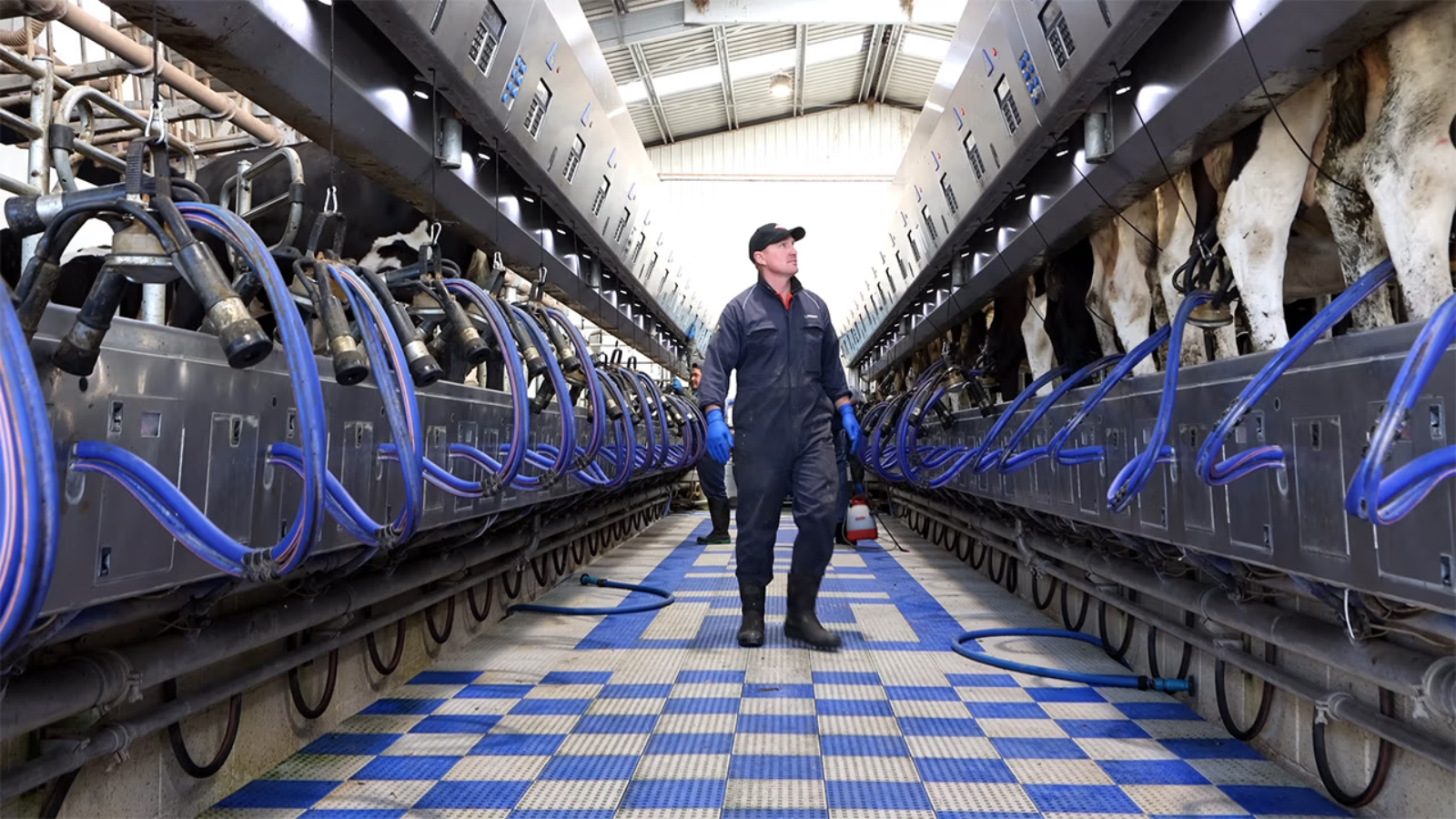
When the Lawrence family built a one-man cow shed to streamline their operation, it sparked their search for wearable technology that could handle heat detection without extra labour.
While efficient, the European-style rapid-exit herringbone shed, built in 2019, also meant a second operator would still be needed for a quarter of the year to identify bulling cows.
“That was the driver to look at wearable technology for mating,” Hayden Lawrence says.
Hayden and wife Alecia peak milk 400 cows on their 177ha dairy farm at Eltham, South Taranaki, under the Niaruo prefix. Originally owned by Hayden’s parents Ray and Joyce, the property is now fully owned by the couple and includes a 153ha effective milking platform and native bush.
The herd is split calved, with 300 cows calving in spring and 100 in autumn. About 75% of the herd is Holstein Friesian, with close to 300 registered pedigree Holstein Friesians.
When Hayden and Alecia began investigating wearable technology, they were not convinced collars were the right fit, having used them for identification in the past.
“They are hard to manage as they get older and we had a few safety issues with cows as well,” Hayden says. “We wanted an alternative, and that’s when we found bolus technology.”
They were drawn to Austrian company smaXtec, although the technology was not yet available in New Zealand.
“We made a few phone calls and sent emails to Austria, and in October 2020 we became the first New Zealand farmers to put smaXtec boluses into our herd,” Hayden says.
Hayden – who also runs precision agriculture business Spatial Solutions Ltd – initially used the system in the spring-calving herd during nine weeks of AB from October to December, without any other heat detection aids.
“It worked so well that in March 2021 we administered boluses to the autumn-calving herd as well,” he says.
For the first three years, support came directly from Austria, which created some challenges. However, in 2023 smaXtec established a New Zealand branch.
“They now have a full sales and support team, and smaXtec technology is on more than 300 New Zealand farms,” Hayden says. “The boluses give us the information we need around cow activity, rumination and temperature.”
The technology was initially adopted for labour efficiency during mating. At Niaruo Farms, spring calvers undergo nine weeks of AB, while autumn calvers undergo four weeks.
“When the shed was built, we realised we would still need a second person in the shed for 14 weeks of the year to identify bulling cows,” Hayden says. “With the boluses, we use insemination windows to maximise breeding efficiency. They do as good a job as a top operator.”
The business produces 150 heifer calves each year, with around 80 entering the herd.
“We focus heavily on genomic technology and use it to select the type of stock we want,” Hayden says. “When selecting bulls, we are very strict on BV. We look for strong production, with a combined production BV of at least 50, udder overall at 0.9, rump width, capacity and positive fertility.”
Hayden and Alecia have used bulls from the Meander April cow family, including Meander SB Alias-ET S2F, Meander Shot Alibi-ET S3F and Meander Max Anchor-ET S2F.
“We used Alibi over our heifers because of his shorter gestation and lower birthweight traits,” Hayden says. “As those bloodlines became more prominent in the herd, we introduced some Double W Ranger genetics for diversity. He produced some amazing type cows, although his stature was slightly large for our rolling-to-hill country.”
However, Hayden says the biggest gains from the boluses have been in animal health.
“We rely heavily on the boluses for animal health data,” he says. “They measure temperature and rumination every five minutes, and help us detect mastitis, ketosis and clinical milk fever.
The boluses enable early detection through abnormal increases in body temperature. Cows flagged with high temperatures are labelled as potential mastitis cases and moved onto the “don’t milk” list.
“We’ve seen a 70% drop in antibiotic use for mastitis, and annual cases have fallen from 50-60 cases to 10-20 across the herd,” Hayden says.
During the first 30 days of lactation, low rumination combined with low temperature alerts can indicate ketosis or milk fever. Those cows are drafted out and given a nutrient mix to support recovery.
“The boluses can give us up to three days’ warning before symptoms appear,” Hayden says.
At calving time, the springer mob is placed on the feed pad after milking, with calving alerts used to draft cows out.
“Ninety-five percent of cows calve in the front paddock, out of the springer mob,” Hayden says.
A climate sensor also monitors the herd’s thermal heat index, allowing staff to respond quickly to heat stress.
“We noticed a lot of ketosis alerts in early spring this season, so we looked at what we could do for the herd as a whole,” Hayden says. “We added Rumenox into the mineral mix and the ketosis alerts disappeared.”
Hayden says the bolus technology works because it is part of a wider management system. Farm staff follow clear protocols at every milking in order to get the most from the technology.
“We actually turned off a lot of the phone alerts because if you are out in the paddock, you can’t do anything with the information, or you tend to forget to follow up,” Hayden says. “Instead, we check the app five minutes before each milking, when we can act on the data.
“You must have protocols in place because if you are not making management decisions from the data, there is no point. We follow a Plan – Measure – Manage – Review system.
“We have even started using AI to pull data from multiple sources for more strategic analysis. It is a really exciting space.
“The boluses act as the fence at the top of the cliff.”
| Owner | Hayden & Alecia Lawrence trading as Niaruo Partnership |
| Location | Eltham, Taranaki |
| Farm size | 153ha milking platform |
| Cows | 400 (75% registered Holstein Friesian) |
| Production | 200,000kgMS |
| Stud name | Niaruo |
Add a Comment
You must be logged in to post a comment